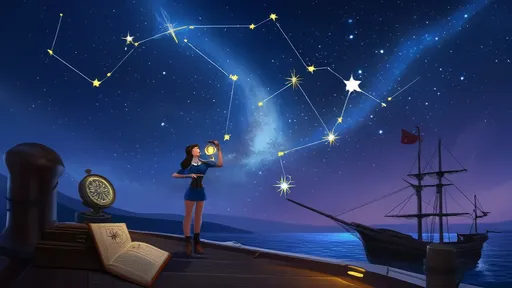
For centuries, humans have looked to the stars for guidance. Long before the invention of GPS or even the compass, ancient mariners and travelers relied on celestial navigation to traverse vast oceans and uncharted territories. The art of finding one’s way by the stars is not just a relic of the past—it remains a vital skill for adventurers, sailors, and even those who simply wish to reconnect with the natural world. This article explores the timeless practice of celestial navigation, focusing on how to locate and use constellations as a guide when modern technology fails.
The night sky is a vast, ever-changing map. Unlike terrestrial maps, which remain fixed, the stars appear to move across the sky due to Earth’s rotation. However, certain patterns—constellations—have been recognized and named by cultures around the world. These groupings of stars serve as celestial landmarks, helping navigators determine direction and even approximate their latitude. The key to using constellations for navigation lies in understanding their positions relative to the horizon and each other.
One of the most famous navigational stars is Polaris, the North Star. Located almost directly above the Earth’s North Pole, Polaris remains nearly stationary in the night sky while other stars appear to revolve around it. This makes it an invaluable reference point for northern hemisphere navigation. To find Polaris, one can use the Big Dipper, a well-known asterism within the constellation Ursa Major. The two stars at the end of the Dipper’s bowl, known as the "pointer stars," trace a line that leads directly to Polaris. Once located, the angle between Polaris and the horizon roughly corresponds to the observer’s latitude.
In the southern hemisphere, where Polaris is not visible, navigators rely on the Southern Cross, or Crux. This compact but distinctive constellation points toward the celestial south pole. By extending an imaginary line from the longer axis of the cross about four and a half times its length, one can approximate the position of the south celestial pole. Unlike Polaris, there is no bright star marking this spot, but the technique remains effective for orientation.
Beyond these primary markers, other constellations can provide additional navigational cues. Orion, for instance, rises in the east and sets in the west, much like the sun. Its belt—three bright stars in a straight line—can help determine east-west orientation. Similarly, the seasonal appearance of certain constellations can indicate the time of year, which was historically useful for planning long journeys.
Celestial navigation also requires an understanding of the celestial sphere—an imaginary dome where stars appear to be fixed. The sphere is divided into degrees, much like a compass, allowing navigators to measure angles between stars and the horizon. A simple tool like a quadrant or even a fist held at arm’s length (which roughly measures 10 degrees) can help estimate these angles. With practice, one can learn to gauge latitude by measuring the height of Polaris or the Southern Cross above the horizon.
Timing is another critical factor. The stars’ positions change not only nightly but throughout the year. Ancient navigators used star charts and almanacs to track these movements, but today, a basic knowledge of the night sky’s rotation can suffice. For example, in the northern hemisphere, Cassiopeia—a W-shaped constellation—rotates around Polaris opposite the Big Dipper. When one is high in the sky, the other is low, providing a constant reference.
Modern technology has made celestial navigation seem obsolete, but there are compelling reasons to keep the practice alive. GPS devices can fail, batteries die, and signals can be jammed or unavailable in remote areas. Knowing how to navigate by the stars is a reliable backup—one that requires no power or infrastructure. Moreover, it fosters a deeper connection to the natural world, something that is often lost in our screen-dominated lives.
Learning celestial navigation takes patience and practice. Start by familiarizing yourself with a few key constellations and their movements. Spend clear nights observing how they shift over hours and seasons. Use simple tools like a planisphere or a star app to aid identification, but try to wean yourself off them over time. The goal is to recognize patterns instinctively, as ancient sailors once did.
In an age where we rely so heavily on technology, the ability to navigate by the stars is both a practical skill and a profound way to engage with the universe. It reminds us that, despite our advancements, we are still part of a much larger cosmos. Whether you’re an avid hiker, a sailor, or simply a stargazer, understanding celestial navigation can transform the way you see the night sky—and the world.

By /Jul 16, 2025

By /Jul 16, 2025

By /Jul 16, 2025

By /Jul 16, 2025

By /Jul 16, 2025

By /Jul 16, 2025
By /Jul 16, 2025

By /Jul 16, 2025

By /Jul 16, 2025

By /Jul 16, 2025

By /Jul 16, 2025

By /Jul 16, 2025

By /Jul 16, 2025

By /Jul 16, 2025

By /Jul 16, 2025
By /Jul 16, 2025

By /Jul 16, 2025
By /Jul 16, 2025

By /Jul 16, 2025

By /Jul 16, 2025
