The turquoise waters lapping against pristine white sands have long been the postcard-perfect image of tropical island resorts. Yet behind this idyllic facade, a silent crisis is unfolding across many coastal properties. Rising sea levels and increasingly violent storm surges are gnawing away at the very foundations of luxury beachfront hotels, forcing architects and engineers to rethink traditional erosion control methods.
On the frontline of this battle stands an unlikely hero – coconut fiber. What was once considered agricultural waste has emerged as a sustainable solution for protecting vulnerable shorelines. Known as coir in the industry, this fibrous material extracted from coconut husks is being woven into sophisticated erosion control systems that blend ecological sensitivity with engineering durability.
The Science Behind Coir's Effectiveness
Unlike concrete seawalls that often exacerbate erosion by redirecting wave energy, coir-based systems work with natural processes. The dense, interlocking fibers create a porous barrier that absorbs wave impact while allowing for gradual water filtration. This permeability prevents the dangerous backwash effect that plagues many hard armor solutions.
Marine biologists have observed another remarkable benefit – coir structures quickly become colonized by native vegetation. The rough texture provides ideal anchoring points for pioneer plant species, whose roots eventually form a living reinforcement network. Within two to three growing seasons, what begins as an artificial barrier transforms into a thriving ecosystem that grows stronger over time.
Case Study: Maldives Resort Renaissance
The Velaa Private Island resort provides a textbook example of coir technology's transformative potential. After losing nearly eight meters of beachfront during consecutive monsoon seasons, management faced a difficult choice between unsightly concrete barriers or retreating inland. Their landscape architect proposed a third way – a coir-based hybrid system.
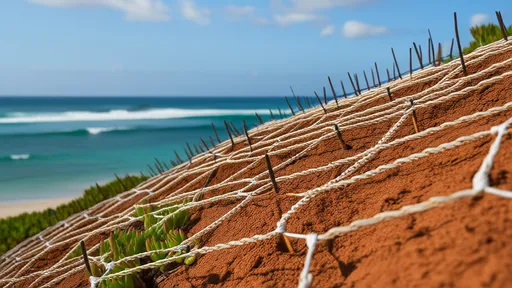
Work crews installed prefabricated coir logs along the most vulnerable sections, staked into place with biodegradable coconut wood pins. These were then covered with coir netting and planted with native beach creepers. The initial investment was comparable to conventional methods, but the long-term savings became apparent almost immediately.
Maintenance costs dropped by 60% compared to the previous rock revetment system. More surprisingly, the resort's house reef showed measurable improvement in water quality parameters within eighteen months, a side benefit attributed to reduced sediment runoff from the stabilized shoreline.
Engineering Innovations in Coir Technology
Modern coir erosion products bear little resemblance to the simple coconut mats used decades ago. Advanced manufacturing techniques now produce three-dimensional geotextiles with precisely engineered pore structures. Some premium products incorporate layers with varying fiber densities to handle different wave energy levels across a single installation.
The latest breakthrough comes from Dutch engineers who've developed a coir composite reinforced with plant-based biopolymers. This material maintains all the ecological benefits of pure coir while achieving compressive strengths approaching that of low-grade concrete. Early adopters in the Caribbean report these enhanced logs withstand Category 2 hurricane conditions without structural compromise.
Perhaps most impressively, these high-performance variants still fully biodegrade within 5-7 years – intentionally timed to coincide with the maturation of the vegetative stabilization system they support.
Balancing Aesthetics and Function
Luxury resorts cannot sacrifice visual appeal for practicality. Recognizing this, landscape designers have elevated coir systems into an art form. Custom-dyed fibers now allow color matching with natural beach sands, while sculpted coir forms create organic-looking transitions between built and natural environments.
At Thailand's Six Senses Yao Noi, the erosion control system doubles as an artistic installation. Wave-like coir terraces planted with flowering beach shrubs have become such a distinctive feature that they appear in the resort's marketing materials. Guests frequently mistake these functional structures for intentional landscape design elements.
The psychological impact shouldn't be underestimated. Where concrete walls create a visible divide between guests and the ocean, coir solutions maintain the illusion of untouched nature – even while performing serious engineering work behind the scenes.
The Carbon Calculus
Beyond shoreline protection, resorts are discovering coir's value in their sustainability accounting. Traditional erosion control methods typically carry heavy carbon penalties from material extraction, manufacturing and transportation. A typical concrete seawall installation might embody 200-300 tons of CO2 equivalent for a modest resort installation.
Coir systems flip this equation. As an agricultural byproduct, production requires minimal additional energy input. More significantly, the material sequesters carbon both through its organic composition and by facilitating the growth of additional plant biomass. Life cycle analyses show most coir installations achieve carbon neutrality within 18 months, with many becoming net carbon negative over their operational lifespan.
For eco-conscious resorts pursuing carbon-neutral certifications, this dual benefit of protecting assets while improving sustainability metrics proves irresistible. Several major hotel chains now mandate coir-based solutions as part of their corporate environmental policies.
Challenges and Limitations
Despite its many advantages, coir technology isn't a panacea. In high-energy environments with constant wave action, even reinforced coir products may degrade faster than their vegetative systems can establish. Some projects in the windward Hawaiian islands have required supplemental temporary protection during initial establishment periods.
Supply chain complexities also exist. While coconut palms grow throughout the tropics, high-quality coir processing remains concentrated in few regions. Sri Lanka and India currently produce about 80% of the world's commercial coir fiber, creating potential bottlenecks as demand grows. Several resorts have begun exploring hyper-local solutions, including small-scale processing facilities that utilize coconuts from their own landscapes.
Perhaps the greatest challenge lies in changing mindsets. Many civil engineers trained in traditional methods remain skeptical of "soft" solutions, despite mounting evidence of their effectiveness. The industry is responding with certification programs and case study databases to build professional confidence in these systems.
The Future of Shoreline Stewardship
As climate change intensifies erosion threats, coir technology continues evolving. Researchers are experimenting with coir-based floating breakwaters for protecting overwater bungalows, while others develop hybrid systems that combine coir with regenerated coral colonies. The next frontier may be "smart" coir products embedded with sensors to monitor structural integrity and environmental conditions in real time.
What began as a traditional craft in coconut-growing regions has blossomed into a sophisticated engineering discipline. For island resorts navigating the twin imperatives of asset protection and environmental responsibility, these humble fibers offer a rare convergence of pragmatism and principle. As one Mauritian resort manager quipped while showing off his new coir installation, "We're not just saving our beach – we're giving the coconuts a chance to return the favor."

By /Jul 16, 2025

By /Jul 16, 2025
By /Jul 16, 2025
By /Jul 16, 2025
By /Jul 16, 2025

By /Jul 16, 2025

By /Jul 16, 2025
By /Jul 16, 2025

By /Jul 16, 2025
By /Jul 16, 2025
By /Jul 16, 2025
By /Jul 16, 2025
By /Jul 16, 2025

By /Jul 16, 2025

By /Jul 16, 2025
By /Jul 16, 2025

By /Jul 16, 2025
By /Jul 16, 2025

By /Jul 16, 2025
By /Jul 16, 2025
